
How I Use AI to Turn My Book Highlights Into Book Notes
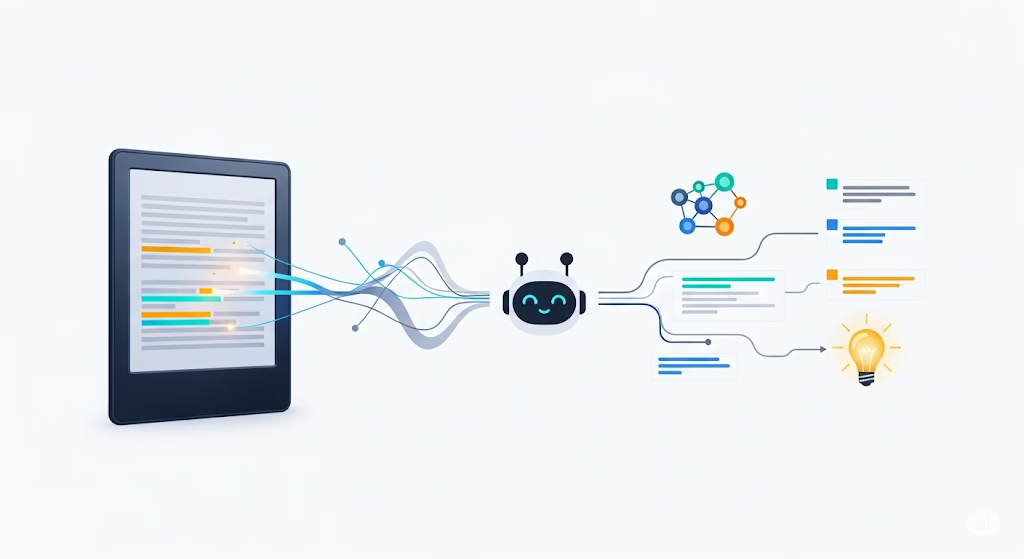
I don't ask AI to summarise entire books. I feed it only my highlights — what I found worth keeping — and let it build a structured reference I can use later. Here is my exact process.
This is an evolving process. Every other week, I make minor adjustments based on a simple rule: I read the book.
My current reading list is over 500 books. My Amazon wish list has over 50 books. My Kindle has over 40 unread books.
It is clear that I will never be able to read them all. In August 2024, I took an easy route to reduce my list: I had AI summarise my unread books.
AI did a good job. I enjoyed reading the summaries.
A few weeks later, I asked Claude for a summary (A) from a book I read. In another session, I asked it to generate summary (B) from my own highlights and notes.
The two summaries looked similar initially. However, summary (A) missed certain sections that made the book worth reading for me.
Summary (A) has its use. It helps me understand if a book is worth reading or not. I know which sections I can skim without any guilt.
When I am reading a book on Kindle, I highlight freely every section that I find interesting. After I finish reading the book, I review every highlight I made.
In this pass, I discard more than half of my highlights. I add my own thoughts to the ones that remain. Most authors repeat the same ideas across chapters, so this process is easier than it appears.
The remaining highlights with my notes become a record of my learning from the book. They go into my Obsidian vault.
If I am reading a physical book or listening to an audiobook, I take notes along the way. I clean these notes the same way.
Every book-note in my vault now serves as my reference document for every book I read.
At this stage, I run my book-note through AI. I use a custom prompt that I update every other week. I share my own understanding of the book: themes, concepts, terms, questions, and observations.
Over the next hour, I work with AI to fine-tune my understanding. Once both of us arrive at a shared understanding, I ask it to write a summary of the book.
I read the draft, make minor edits and structure it differently if needed. I add the final draft to my vault and link it to my book-note.
AI serves as an organising tool for me.
I could stop here and pat myself for a job well done. But I publish this essay on my blog. I state clearly that this essay is AI-assisted.
The publishing process encourages me to transform this essay into a "standalone essay." I need to explain the topic clearly and give the background a stranger would need. I also need to reach a conclusion without pointing back to other essays.
That final pass makes the essay easier for my future self to read and use.