Rework - Reference Document
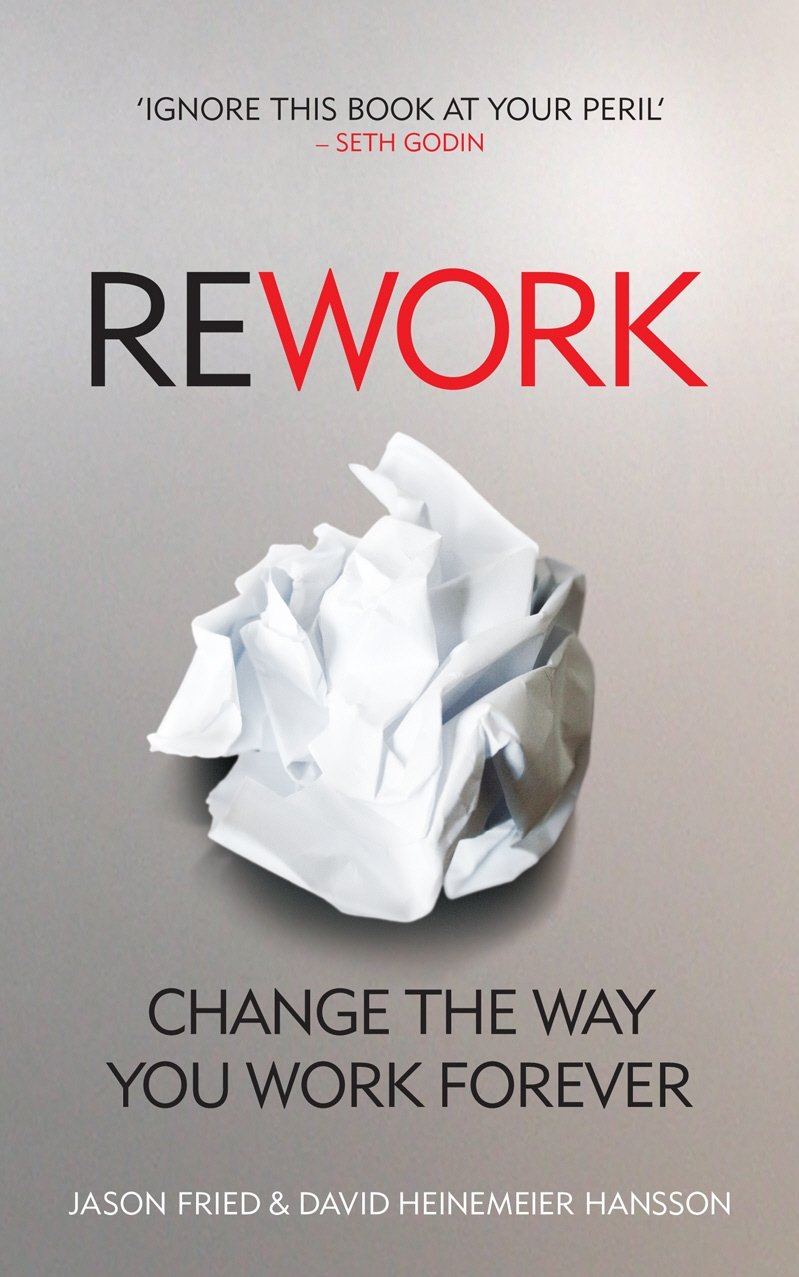
Jason Fried and David Heinemeier Hansson
This document draws on 16 pages of handwritten notes from Rework, the later working draft in which I reorganised the book’s ideas through my own operating experience. The three-phase structure, business-unit lens, economic tests, and several operating rules are my own synthesis
AI-drafted. The thinking, structure, and research were developed by me in conversation with AI; the final document was generated by AI and edited for accuracy.
Key Takeaway
Rework is best read as the Basecamp founders’ manifesto for building a profitable, independent, focused and deliberately light business: not a universal operating manual, but a useful set of brakes against raising money, hiring, growing, meeting, adding features and creating process merely because established business practice says that one should.
Glossary
MANIFESTO: A forceful statement of the kind of business the authors believe is worth building. It expresses a coherent preference rather than proving that every business should follow the same route.
Why it matters: Rework becomes more useful when its claims are treated as challenges to conventional assumptions rather than universal laws.
BUSINESS UNIT: The smallest useful commercial boundary within which revenue, cost, capital, operations and risk can be understood. It may be a product, geography, service line, customer segment or operating model.
Why it matters: A company can contain mature, experimental and deteriorating units at the same time.
DOMINANT QUESTION: The main uncertainty that a business unit must resolve at a given point. Other parts of the unit may require different work without forcing the whole unit into one neat stage.
Why it matters: It keeps the three-phase model from becoming a rigid startup sequence.
TRANSACTION CONTRIBUTION: The amount left from a normal transaction after paying the incremental cash costs caused by that transaction.
Common confusion: Positive contribution does not prove that the complete business is profitable.
COMPLETE UNIT ECONOMICS: The full economics of operating a business unit, including salaries, acquisition, management, technology, compliance, bad debt, financing, working capital, overhead and the cost of exceptions.
Why it matters: A useful product and a profitable transaction may still fail to support a complete business.
SURVIVAL REVENUE: The minimum recurring revenue required to cover the business’s unavoidable cash costs and keep it operating.
Why it matters: A lower survival threshold gives the owner more time, negotiating freedom and capacity to refuse unattractive growth.
Common confusion: It is not the same as a desirable revenue target or acceptable long-term return.
ORGANISATIONAL MASS: Commitments that make change expensive. These include excess staff, long contracts, inventory, technical lock-in, thick processes, permanent decisions and unnecessary management layers.
Analogy: More mass requires more force to change direction.
Common confusion: Structure is not automatically mass. Some structure is required for reliability.
EASY FIX: An intervention that removes immediate pain, often by adding another patch, person, approval or tool.
Why it matters: Easy fixes can be rational while the business is still discovering how the work functions.
SIMPLE SYSTEM: A design built around the underlying problem after recurring patterns have become visible. It removes unnecessary elements but may require more thought and effort than an easy fix.
Common confusion: Simple does not mean crude, incomplete or effortless.
OWNER FIT: Whether the founder is willing and able to own the real operating conditions, risks, cadence and organisational demands of a business.
Why it matters: A commercially valid opportunity may still be the wrong business for a particular owner.
Common confusion: Personal preference can also hide fear or resistance to necessary change.
ENDURANCE: The ability of a business to remain economically viable through normal shocks, operate without repeated founder rescue, and detect weakening assumptions early enough to respond.
Why it matters: Endurance requires adaptation. It does not mean preserving the current system forever.
Propositions
P1. Rework should be read as a manifesto and a set of brakes
Epistemic status: Kiran’s interpretation of the authors’ philosophy.
Rework is less a neutral study of how businesses work than an explanation of the business the Basecamp founders chose to own. Their positions on planning, funding, hiring, growth, meetings and product scope follow from a preference for independence, profitability, clarity and low organisational weight.
That coherence is the book’s strength. It is also its limit. Growth is not automatically harmful. Funding is not automatically destructive. Meetings are not always wasteful. Remaining small is an owner’s choice, not a law of business.
The useful move is to convert the authors’ commands into pauses. Before adding money, people, features or process, ask what real constraint the addition solves. This preserves the force of the book without copying Basecamp’s choices blindly.
Recall when: A conventional business practice is being treated as an unavoidable next step.
Memory line: Use Rework as a brake against automatic business behaviour, not as a new set of automatic rules.
Source: Working draft, opening assertion and personal reflections.
P2. Build a business capable of enduring even when no buyer appears
Epistemic status: Author claim accepted by Kiran.
The authors argue for a commitment strategy rather than an exit strategy. Kiran agrees with the underlying principle: design the company to continue serving customers and generating cash, even if ownership may change later.
Building mainly for sale can distort ordinary decisions. Customer value may become secondary to what an acquirer will reward. Revenue growth can displace profit. Systems may be made impressive for due diligence rather than useful in daily work. Difficult investments may be postponed because a future owner is expected to inherit the consequences.
This does not mean that selling a business is wrong. An owner’s circumstances can change. A buyer may offer a compelling price or possess capabilities the present owner lacks. The distinction concerns the design assumption. Sale should remain an option, not the condition required for the business to make sense.
Recall when: A long-term decision is being judged mainly by how it will affect valuation or acquisition appeal.
Memory line: Build a business worth continuing before building one worth selling.
Source: Working draft, “Build to endure, not to exit.”
P3. Survive the short run without making the long run impossible
Epistemic status: Kiran’s synthesis built from Rework’s bias towards action and simplicity.
An early business may rationally rely on founder effort, spreadsheets, manual delivery, temporary tools and inelegant fixes. The business is still learning what customers need, which exceptions recur, how delivery works and where costs appear. Prematurely formalising an unstable process can freeze guesses into systems.
The danger begins when the pattern becomes stable but the patches continue. A quick fix has then finished its learning function. Each additional patch adds dependencies while hiding the underlying structure.
The transition should be triggered by repetition. When the same workflow, failure and exception appear often enough to be understood, the business should replace accumulated easy fixes with a simpler system built from first principles.
The opposite error is redesigning too soon. An elegant system constructed before the work is understood may solve an imagined process rather than the real one.
Recall when: A temporary workaround has become normal operating procedure.
Memory line: Use patches to learn, then remove them before they become the business.
Source: Working draft, “Survive first, then move from easy fixes towards simple systems.”
P4. Think slowly, then act quickly through small and recorded bets
Epistemic status: Kiran’s modification of the authors’ scepticism towards planning.
Plans are useful for exposing assumptions and coordinating action. They become dangerous when treated as predictions. Kiran’s alternative is to think slowly about the problem, constraints, risks and conditions for success, then test those assumptions through small, bounded moves.
The operating loop is plan, test, observe, update and test again. The small bet limits the cost of error while producing evidence that thought alone cannot supply.
A living plan creates a subtler risk. By editing the same document, the decision-maker can erase failed assumptions and make the final plan appear wiser than the original reasoning. The answer is a changelog. Significant revisions should record what changed, why it changed and what evidence caused the update.
This principle applies when learning can be obtained through reversible action. High-consequence decisions may require more preparation and tighter pre-commitments before testing begins.
Recall when: Planning continues without producing evidence, or a plan changes without preserving why.
Memory line: Move quickly through the world, but leave a record of what you believed before the world corrected you.
Source: Working draft, “Think slowly, then act quickly through small bets.”
P5. The business unit is a better level of analysis than the company
Epistemic status: Kiran’s synthesis.
A company rarely moves as one object from startup to maturity. It may contain an established service line, a deteriorating geography, a new product and an experimental operating model at the same time. Evaluating the whole company through one phase conceals these differences.
The better unit is whichever boundary makes revenue, direct cost, capital, work and risk understandable. Units may share accountants, HR, technology, offices or management. Independence is not required. The boundary should remain useful rather than becoming an accounting fiction.
A phase describes the unit’s dominant question, not every component. A mature staffing unit may remain in Phase 3 while falling margins require Phase 2 economic work and a proposed gig model begins Phase 1 validation.
The limitation is that flexible boundaries can be manipulated. A weak unit can be bundled with a stronger one, or shared costs can be allocated in a way that hides its true burden.
Recall when: One company-level conclusion is being applied to businesses with different economics or maturity.
Memory line: Define the unit narrowly enough to see what is actually being proven, funded and operated.
Source: Working draft, business-unit explanation and phase interaction.
P6. Phase 1 asks whether I should build this business
Epistemic status: Kiran’s synthesis using Rework’s ideas about real problems, direct experience, small launches and constraints.
Phase 1 must prove a narrow proposition. A real problem exists. The proposed solution works sufficiently well. Customers will pay under realistic conditions. A normal transaction leaves positive contribution. The initial capital path is feasible.
A few customers can prove that the transaction is real. They cannot prove market size, repeatable acquisition, resilience or complete profitability.
Kiran adds two tests that are largely absent from conventional opportunity analysis. Owner fit asks whether he wants to own the actual cadence, people, risks and discomfort of the business. Portfolio fit asks whether the unit makes reasonable use of the wider company’s capital, capabilities and management attention.
Owner fit must not become a polite name for avoidance. Rejecting an uncomfortable opportunity requires a second question: what happens to the existing business over the next three years if the opportunity is refused?
Recall when: An opportunity appears commercially attractive but operationally undesirable.
Memory line: A business may deserve to exist without being a business I should build.
Source: Working draft, Phase 1 definition, owner fit and exit conditions.
P7. Phase 2 proves that a complete business can support itself
Epistemic status: Kiran’s synthesis informed by his service-business experience.
Phase 1 proves that a commercially valid transaction exists. Phase 2 tests whether the whole unit can repeatedly acquire, serve and retain customers while supporting the organisation required to do so.
The economic test expands from direct contribution to salaries, customer acquisition, management, compliance, bad debt, technology, working capital, financing, overhead, shared-resource capacity and recurring exceptions. A business can be profitable yet still produce an unattractive return on the capital and founder attention committed to it.
The operating test is consistency and reliability across a meaningful cycle. For Kiran’s service businesses, the working threshold is at least three to four months of repeated delivery, staffing, payroll, billing, collection and exception handling. This is personal, not universal. A seasonal business may require a year.
If repeated corrections do not create stability, the question should change from improving the current model to redesigning, merging or stopping it.
Recall when: Early demand is being mistaken for proof that the complete business works.
Memory line: Phase 1 proves a transaction; Phase 2 proves the organisation behind it.
Source: Working draft, Phase 2 economics and operating-cycle tests.
P8. External capital can extend Phase 2 but cannot complete it
Epistemic status: Kiran’s qualification of Basecamp’s funding scepticism.
The Basecamp founders are right that external money changes behaviour. It can encourage spending before the model is understood, shift attention towards investor expectations and impose a growth rate that the economics cannot support.
Kiran does not accept the stronger claim that outside funding is generally bad. Capital may be necessary. An investor may also provide capability, access, hiring help, partnerships or governance that materially improves the odds of success.
The correct evaluation is not money versus no money. It is cash, capability, access and obligations. Equity, debt, supplier credit, customer advances and internal funds may provide the same rupee while creating different deadlines, risks and decision rights.
The boundary is self-sustainability. Capital can provide more time to build a viable unit. Continual access to new capital cannot itself count as proof that the unit has passed Phase 2.
Recall when: Fundraising success is being presented as evidence that the business model works.
Memory line: Capital can finance the search for sustainability; it cannot substitute for sustainability.
Source: Working draft, funding discussion and Phase 2 capital rule.
P9. Phase 3 replaces constant rescue with management control
Epistemic status: Kiran’s synthesis.
Phase 3 begins when the unit generates positive cash flow, delivers reliably and has a sufficiently understood operating method. The owner does not disappear. The owner’s work changes from routine approvals, firefighting and exception chasing towards capital allocation, system design, major customer decisions and control.
Control should first be constructed from the bottom up. The owner must understand how margins are calculated, where overhead arises, how collections affect cash and which operating events move the topline numbers. Once this understanding exists, management can work mainly from the top down.
Key measures should have predefined acceptable ranges. Normal management continues within those ranges. A breach triggers investigation into whether the cause is temporary, execution-related or structural. Escalation reaches the owner when a business decision is required, not for every operating variance.
The limitation is false comfort. A clean dashboard can conceal poor definitions, stale data or customer realities that no metric captures.
Recall when: The owner is involved in every event but still lacks a clear view of business health.
Memory line: Understand the business from the bottom up, then control it from the top down through exceptions.
Source: Working draft, Phase 3 role and management-control design.
P10. Growth must earn the complexity it creates
Epistemic status: Kiran’s modification of the book’s preference for remaining small.
The valuable lesson in Rework is not that every business should remain small. It is that growth should not be inherited as the default goal.
Growth is useful when demand is real and the business can serve it without disproportionate capital, noise or organisational weight. It becomes destructive when revenue rises while margins fall, working capital expands, founder control weakens or service quality becomes harder to maintain.
The correct size of a business also reflects owner preference. One founder may value control and high cash generation. Another may accept more people, capital and risk to pursue a larger opportunity. Neither choice is automatically superior.
Customer concentration follows the same logic. No percentage is universally safe. The practical test is whether the remaining portfolio can cover unavoidable costs and absorb the adjustment if a major customer leaves. Unit-level exposure and portfolio-level survivability must both remain visible.
Recall when: Growth is proposed because a larger business is assumed to be a better business.
Memory line: Add size only when the value created exceeds the complexity and exposure added.
Source: Working draft, growth and customer-concentration analysis.
P11. Low unavoidable costs increase strategic independence
Epistemic status: Author claim from Jason Fried’s later interview, expanded through Kiran’s business lens.
Jason Fried sharpens the low-overhead argument by claiming that a company’s primary competition is its own cost structure. The literal claim is too strong: competitors can still alter prices, customer expectations, distribution and market size. The mechanism underneath it is useful.
A business with low unavoidable costs needs less recurring revenue to survive. That reduces its dependence on continuous growth, outside capital and favourable market conditions. It also gives the owner more time to recover from customer loss, correct mistakes and refuse contracts that weaken the business.
This is not the same as indiscriminate cost cutting. Removing capacity that customers depend on can destroy the business. The principle applies to costs that have become permanent without producing equivalent customer value, risk reduction or operating strength.
In manpower-heavy or regulated businesses, the minimum cost base may remain high. The useful task is to separate unavoidable delivery costs from accumulated organisational weight.
Recall when: A new fixed cost is justified by expected future growth rather than a present operating constraint.
Memory line: The less revenue required merely to stay alive, the fewer outside forces can dictate the next decision.
Source: Jason Fried interview reference supplied by Kiran, “Your Only Competition Is Your Costs.”
P12. Repeated exceptions reveal the real service being sold
Epistemic status: Kiran’s operating inference.
A customer request may begin as a one-off accommodation. When the same work recurs, it is no longer an exception. The business has either misunderstood its service, failed to enforce its boundaries, or allowed the customer’s needs to change without updating the commercial model.
The recurring work must become a standard workflow, a priced addition, a simplified or automated process, a narrower agreement, or an explicit exclusion. Ignoring it creates service creep: the actual service becomes larger than the service that was designed and priced.
Automation can reduce the labour required, but it does not make unlimited service expansion free. Automated work still creates design, maintenance and exception costs.
This proposition matters most in service businesses, where small accommodations can accumulate invisibly across contracts. It is less applicable when customisation is deliberately priced as the product.
Recall when: A task is still being called “ad hoc” after appearing across several customers or operating cycles.
Memory line: A recurring exception is part of the service, whether or not the contract admits it.
Source: Working draft, service-creep analysis.
P13. A business is never permanently proven
Epistemic status: Kiran’s synthesis.
A business can pass all three phases and still weaken later. Technology, customer behaviour, regulation, costs, competition and internal capacity can change the assumptions on which the unit was built.
This does not mean that every poor quarter sends the whole business backwards. A phase represents the dominant question. When one assumption weakens, that question returns to the phase where it must be reproven. Falling margins may require Phase 2 economic redesign. A new geography may require Phase 1 testing. The mature unit can remain otherwise intact.
A failed unit should not always be forgotten. If the problem and solution were valid but labour cost, technology or capital requirements made the model uneconomic, the learning can be preserved as a dormant option. Changed conditions may later justify reopening it.
The decision consequence is continuous audit without continuous upheaval.
Recall when: Past success is being used as evidence that a current assumption no longer needs testing.
Memory line: Preserve what has been proven, but never confuse earlier proof with permanent truth.
Source: Working draft, dormant options, recurring audit and phase interaction.
Observations
Author observation: Large tasks are estimated poorly. Breaking them into smaller units does not remove uncertainty, but each completed unit improves the information available for estimating the next one.
Author observation: Culture forms through repeated behaviour. Employees observe how decisions are made, whether mistakes are discussed, whether urgency is abused and what conduct is rewarded.
Author observation: Fixing the time and available team forces scope decisions. When time, budget and scope are all allowed to expand, optional work gradually becomes mandatory.
Author observation: A low-cost software company can remain profitable with a relatively small customer base, which reduces its exposure to capital markets and growth pressure.
Kiran’s operating observation: Contract margins can deteriorate after work begins, while company overhead can rise without becoming visible inside individual contract reports.
Kiran’s operating observation: An occasional delayed payment may be routine variance. Repeated delays change the issue from collection follow-up to a decision about pricing, exposure and whether the customer should be retained.
Kiran’s operating observation: Revenue-based overhead allocation is useful but incomplete. It does not reveal how much management attention, exception handling or operational strain a unit creates.
Kiran’s operating observation: Several months of delivery are usually required before recurring service obligations, customer behaviour, billing problems and operating exceptions become visible in his service businesses.
Extractor inference: Repeated founder intervention does not always prove that the business is bad. It does show that the process, authority structure, staffing or information system remains incomplete.
Extractor inference: A profitable unit may remain undesirable when it consumes disproportionate working capital, management attention or portfolio risk.
Tensions and Limits
A coherent philosophy versus a universal theory
Rework is persuasive because its positions reinforce one another. Independence supports frugality. Frugality supports small teams. Small teams support low process. Low process supports speed.
The same coherence can hide selection effects. Basecamp’s product, market, margins, founders and customer model may support choices that fail in regulated, capital-intensive or manpower-heavy businesses.
The book is most credible as an account of what the founders deliberately chose. It becomes less credible when preference is stated as a law for every business.
Low costs versus insufficient capacity
Low fixed costs reduce the revenue needed for survival and preserve freedom. They can also become a misleading objective if the business cuts capacity, controls or expertise required for dependable delivery.
The important distinction is between cost that supports the promise and cost that merely reflects accumulated organisational weight.
A low-cost business that repeatedly fails customers is not resilient. It is underbuilt.
Short-run survival versus long-run simplicity
Quick fixes can preserve cash, deliver for a customer and expose how work actually functions. Rejecting them too early may kill the business before the elegant system can be built.
The same fixes become liabilities when the pattern has stabilised. Continuing to patch then increases fragility and hides the true process.
The unresolved judgment is when discovery has produced enough repetition to justify redesign.
Fixed time versus non-negotiable requirements
Fixed time horizons force prioritisation and expose bloated scope. They work well when the team can remove optional features while preserving the essential outcome.
The method fails when omitted work creates unacceptable safety, legal, security, accounting or compliance risk. In such cases, the deadline, resource level or release boundary may need to change.
“Vary scope” is not permission to disguise incomplete mandatory work as a finished product.
Owner fit versus strategic avoidance
An owner should not pursue every valid opportunity. The operating life created by the business is a legitimate part of the investment decision.
But “this is not the business I want” can conceal fear of new technology, changed customer behaviour or unfamiliar work. The rejection test must expose what happens to the existing business if the opportunity is refused.
Preference is legitimate only when the owner accepts its consequences.
Staying light versus building sufficient capacity
Low organisational mass preserves adaptability. Too little capacity can create service failures, exhausted employees, weak controls and permanent founder rescue.
The correct goal is not minimum structure. It is sufficient structure without unnecessary weight.
Smallness is valuable when it protects judgment and change. It fails when the cost is transferred to customers or employees.
Stability versus continuous improvement
A stable system should not be redesigned merely because a more elegant method is available. Continuous change can make dependable execution impossible.
The opposite danger is allowing stability to become complacency. A system can remain internally consistent while customer demand, economics or technology move against it.
Change is justified when goals change, results breach defined ranges, operating conditions shift or the downside of waiting becomes material.
A three-to-four-month test versus slower risks
Three to four months may reveal normal payroll, billing, collection and service cycles in Kiran’s present businesses. It cannot expose every seasonal, regulatory or annual risk.
The broader principle is to observe the longest material operating cycle. Kiran’s threshold is a practical trigger for review, not proof that every hidden problem has appeared.
Unit economics versus portfolio advantage
A unit can benefit legitimately from shared teams, systems and capital. The wider portfolio may absorb risks that the unit cannot survive alone.
Portfolio support can also hide an unattractive unit. A business that appears profitable only because its management burden, shared-resource use or capital exposure is ignored has not been honestly evaluated.
Both unit-level weakness and company-level survivability must remain visible.
Rules
When reading a strong claim from Rework, convert it into a question before adopting it, because the claim often reflects Basecamp’s chosen business rather than a universal law. Do not apply this when the underlying principle is already supported by direct evidence in the business being examined.
When defining a business unit, include enough revenue, cost, capital, operating work and risk to make the decision legible, because an arbitrary boundary can hide weak economics. Do not require the unit to duplicate shared company resources.
When testing a new opportunity, prove the problem, solution, realistic payment, positive normal transaction contribution and initial capital path, because early enthusiasm does not prove a viable commercial transaction. Do not treat a few paying customers as proof of repeatable acquisition or complete profitability.
When rejecting an opportunity because it does not fit the owner, state the three-year consequence of rejection, because personal preference can hide strategic avoidance. Do not pursue a business merely because refusing it feels uncomfortable.
When a temporary workaround begins handling a stable and repeated pattern, replace it with a simpler system, because the patch has finished its learning function. Do not formalise the process while major assumptions are still changing.
When the deadline and available team are fixed, reduce scope until the smallest complete result fits, because open-ended time allows optional work to become mandatory. Do not remove legal, safety, security, accounting or compliance requirements to preserve the deadline.
When a plan changes materially, record the earlier assumption, the evidence received and the reason for the update, because edited plans allow memory to rewrite the quality of the original decision. Do not create heavy documentation for trivial and easily reversible choices.
When evaluating Phase 2, include complete operating costs, working capital, survival revenue and return on capital, because transaction contribution alone can conceal an unattractive business. Do not cut capacity that the core customer promise requires merely to lower the cost base.
When an exception recurs, standardise, simplify, automate, price or exclude it, because repeated exceptions are part of the real service. Do not automate work merely to avoid a necessary discussion about scope or price.
When a key measure leaves its predefined range, investigate whether the cause is temporary, execution-related or structural before escalating, because the owner should make business decisions rather than personally manage every variance. Do not wait for a trend when the downside of delay is severe.
Questions for the Book Memo
Which parts of Rework appeal to me because evidence supports them, and which appeal because Basecamp’s preferences resemble my own?
What real decision in Knighthood or O9X changed because I read the book? Without that example, is this still a Learning from Books memo or merely an attractive synthesis?
What level of cash generation, owner involvement, organisational size and risk would make this business “enough”? What specific problem would further growth solve after that point?
Which one or two operating examples can make the three phases concrete without turning the memo into a general management textbook?
Where have I labelled reluctance as “owner fit” without stating what refusing the opportunity will cost over the next three years?
Which current unit has a commercially valid transaction but has not yet proved complete unit economics, repeatable acquisition or acceptable return on capital?
What is the longest material operating cycle for each unit, and where might my three-to-four-month rule create false confidence?
Which profitable unit consumes more working capital, fixed cost, management attention or exception handling than its reported margin reveals?
Where am I extending time because I have refused to reduce scope? Which parts are essential, and which have become mandatory only through habit?
Which current “exception” has repeated often enough that I must either redesign the workflow, change the price, narrow the agreement or stop providing it?