
Books I Recommend For Reading
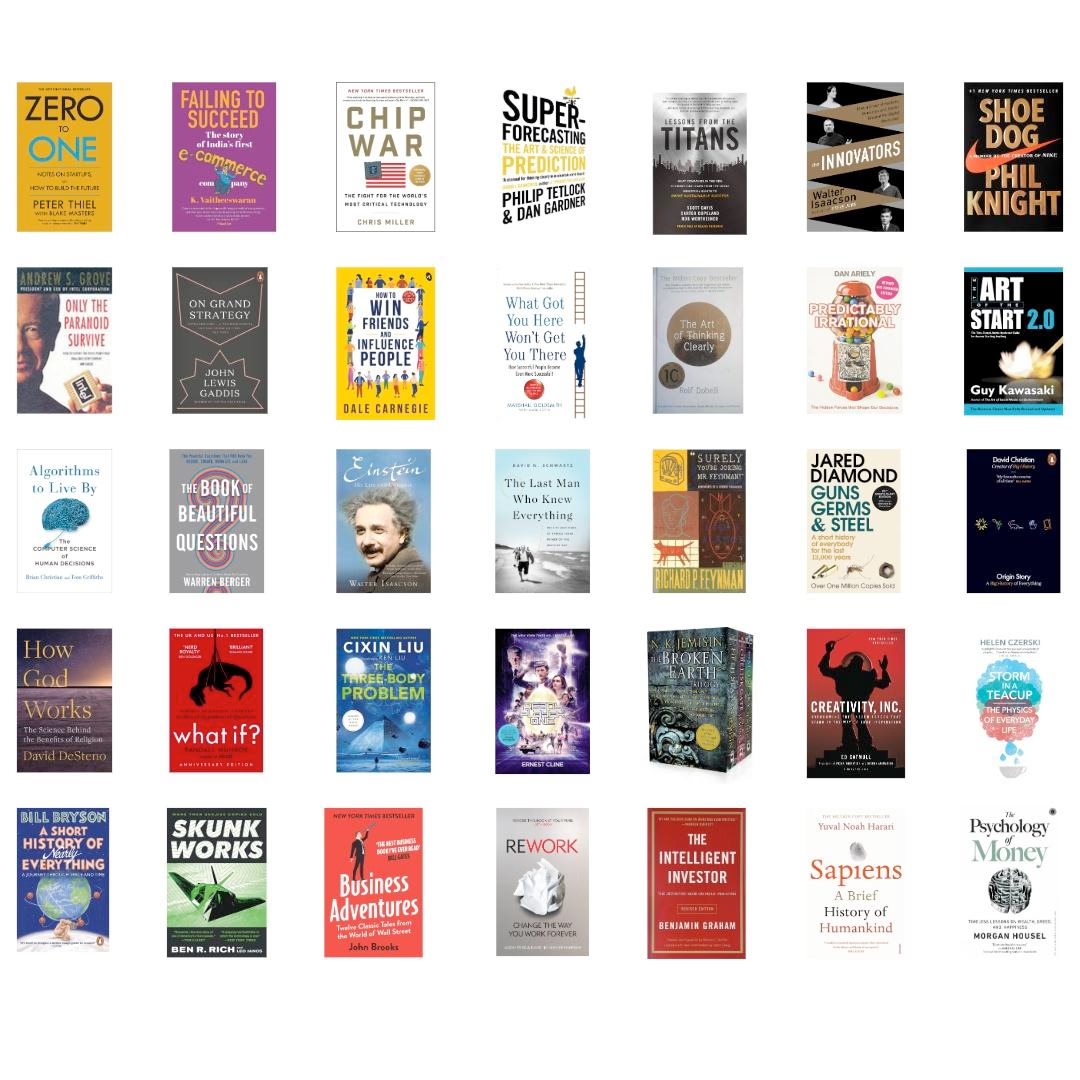
Curated reading list of practical business books for entrepreneurs. From startup advice to decision-making frameworks, these books offer actionable wisdom over theory
My Reading List: Notes from the Messy Middle
I don't read to collect insights. I read to upgrade how I think. Writing about what I've read forces me to actually understand it, not just highlight it. This list isn't a recommendation. It's my working notes on books that changed how I operate.
These aren't books I've skimmed. They're the ones that survived the noise: specific tools, mental models, and hard lessons that helped me navigate building a staffing business, walking away from bad deals, and figuring out AI without burning cash.
Business Biographies
Business biographies offer something textbooks can't: the messy reality of building companies. These aren't sanitised success stories. They're honest accounts of decisions, failures, and breakthroughs.
Shoe Dog by Phil Knight
Knight's terror about "The Float" hit me in the gut. In my staffing business, I pay thousands of workers by the 7th of every month. My customers pay me on 30 to 45 day credit. That gap is where businesses die. I'm constantly calculating: at what point do I push back? Customers don't like being pushed. But over time, when they see consistent service, they start paying on time. Knight showed me that cash flow negotiation isn't about being liked. It's about surviving long enough to earn respect.
Innovators by Walter Isaacson
We're obsessed with the myth of the "Lone Genius" in a garage. Isaacson dismantles this. He tracks the history of the digital revolution to prove that innovation is a team sport. It requires a specific mix: a visionary needs a builder. If you're trying to build everything yourself, you aren't an innovator. You're a bottleneck.
The Ride of a Lifetime by Robert Iger
Most CEOs manage the status quo. Iger managed a complete identity shift. His tenure is the clearest study I've found in the Innovator's Dilemma: how to eat your own cash cows (cable TV) to build the future (streaming) before someone else kills you. His approach to the Pixar and Marvel acquisitions shows how to buy value without destroying the culture that created it.
Failing to Succeed by K. Vaitheeswaran
Failure stories from Silicon Valley are cheap. This is the real thing. Vaitheeswaran built India's first e-commerce company (Indiaplaza) and watched it collapse while Flipkart and Amazon soared. This is a painful, necessary look at "First Mover Disadvantage." Being first isn't enough. You need capital velocity and timing.
Bad Blood by John Carreyrou
This is the anti-pattern manual. It shows exactly what happens when "fake it 'til you make it" crosses into fraud. Theranos is a case study in how lack of technical due diligence and a culture of fear can destroy billions. Physics and biology don't care about your reality distortion field.
Skunk Works by Ben Rich
How do you build the SR-71 Blackbird, a plane faster than a bullet, in the 1960s with slide rules? Small teams, radical autonomy, zero bureaucracy. This book proves that constraints (time, secrecy, budget) fuel innovation, while bloated committees kill it.
Business Adventures by John Brooks
Warren Buffett's favourite business book, for good reason. Twelve critical moments in corporate history, from the Ford Edsel disaster onward. The technology changes, but human nature doesn't. The way executives hide failures, markets panic, and bold bets go wrong is identical in 1960 and 2024.
Creativity, Inc. by Ed Catmull
Catmull's "Braintrust" concept hit different after I'd learned this lesson the hard way. I've launched changes without taking feedback from staff or friends, and watched them fail spectacularly, forcing me back to old ways. Expensive lessons. Now I'm building an ERP for my business differently: feedback at every stage, changing course based on what my team actually says, moving slowly. I'd rather spend four months deploying something that works than one month building something that fails. The Braintrust isn't about being democratic. It's about being honest before you're embarrassed.
Only the Paranoid Survive by Andy Grove
Grove's "Strategic Inflection Points" framework saved me from a slow death. In 2021, post-COVID, my largest customer wanted to renegotiate our ₹48 lakh monthly contract by reducing our fees from 5% to 3% and extending payment terms to 60 days. I ran the math. We were already cash-flow negative at 5% with 45-day terms. At their proposed terms, every transaction would lose money. The inflection point wasn't the negotiation. It was realising that revenue growth could kill us faster than revenue loss. I walked away from ₹5.76 crores annually. Grove taught me to recognise when the game has changed and the old playbook becomes a liability.
Business Management & Leadership
Frameworks for managing yourself and others.
On Grand Strategy by John Lewis Gaddis
Two ideas from this book rewired my thinking. First: intelligence isn't holding one strong view but the ability to hold two opposing views at the same time and still function. Second: be a fox (flexible, adaptive) when exploring, but become a hedgehog (focused, relentless) when you've found clarity. I toggle between these modes constantly: exploring with AI experiments on one side, hedgehog-focused on core staffing operations on the other. The deeper lesson is that history provides patterns that remain true even in the AI age. The technology changes. Human nature doesn't.
What Got You Here Won't Get You There by Marshall Goldsmith
This book is a mirror you don't want to look into, which is exactly why you should. Goldsmith lays bare the habits that got you early success but now hold you back. I recognised several in myself. Some I've fixed. Others I'm still working on. But the deeper lesson isn't about specific behaviours. It's about acknowledging that luck plays a larger role in your success than you'd like to admit. Once you accept that, you stop defending bad habits as "what made me successful" and start seeing them as liabilities.
How to Win Friends and Influence People by Dale Carnegie
I re-read this book every few years, not to learn something new, but for recalibration. Carnegie's principles aren't revolutionary. They're obvious. That's the problem. We know we should listen more than we talk, use people's names, make others feel important. But under pressure, we forget. This book is a reset button for emotional intelligence. It won't teach you anything you don't already know. It will remind you of everything you keep forgetting.
Decision Making
Debugging your cognitive software.
The Art of Thinking Clearly by Rolf Dobelli
Your brain has bugs. Dobelli catalogs 99 of them. As an entrepreneur, you're constantly making high-stakes bets with imperfect information. If you don't understand Survivorship Bias (copying winners without seeing losers) or the Sunk Cost Fallacy (throwing good money after bad), you will lose.
Superforecasting by Philip Tetlock
This book cured me of prediction addiction. We all think we can forecast the future. We can't. Tetlock's research proves most experts perform worse than dart-throwing chimps. What I took away: gather the best information you can within a defined time window, make your decision, then stay open to revising when new data arrives. I don't assign probabilities to business decisions, but I've stopped treating my choices as predictions. They're educated guesses, and admitting that upfront makes it easier to change course when reality disagrees with your spreadsheet.
Predictably Irrational by Dan Ariely
This book changed how I price services. We talk about "value propositions" and "ROI for customers", but humans don't buy rationally. They buy emotionally and justify logically. Ariely showed me that customers feel better about a deal they negotiated than a fair price handed to them. So now I price 10 to 20% higher than my target. When they ask for a discount, I remove services they don't actually need and give them the cut. They feel they've worked out a great deal. I hit my margin. Everyone wins, but only because I stopped pretending customers are spreadsheets.
Startup
Tactical guides for the zero-to-one phase.
ReWork by Jason Fried & David Heinemeier Hansson
"Planning is guessing" lands like a slap. I'd spent years in corporate roles (L&T, Jio, Ola) burning three to four weeks on quarterly planning. Elaborate presentations, aligned OKRs, the whole performance. Then we'd do whatever the market demanded anyway. We never hit those targets. It was corporate theatre disguised as a plan. ReWork validated what I'd felt but couldn't articulate: most planning is procrastination with a spreadsheet. Now I plan in weeks, not quarters. And I actually hit my targets.
The Hard Thing About Hard Things by Ben Horowitz
When I took over my father's business after his sudden death in 2019, I was working with one of my closest friends. We'd committed fully to building something together. Then reality hit. I had to walk away from our plans. He had to figure it out alone. Our friendship survived, but this isn't a moment I'm proud of. Horowitz writes about the decisions that keep you up at night, the ones where there's no clean answer. This book didn't give me comfort. It gave me permission to make hard calls and live with the weight.
Zero to One by Peter Thiel
I don't share the widespread enthusiasm for this book, and that's precisely why it's on this list. Thiel writes for VC-funded founders chasing monopolies. I run a bootstrapped staffing business in Faridabad. But dismissing a book because you disagree with its worldview is lazy thinking. Thiel's observations on distribution ("sales and distribution are as important as product"), niche dominance, and how monopolies actually form apply regardless of your funding status. I take what fits, ignore the VC theatre, and move on. That's the whole point of reading: filter for your context, not someone else's.
Art of the Start 2.0 by Guy Kawasaki
Where Thiel gives you philosophy, Kawasaki gives you the checklist. This is the tactical quick-start guide. From the 10/20/30 rule of PowerPoint to bootstrapping, Kawasaki cuts the fluff. It's about getting going, not getting it perfect.
Finance & Investment
The physics of capital.
The Intelligent Investor by Benjamin Graham
Graham's "Margin of Safety" isn't just an investing concept. It's a life operating system. I apply it to every significant decision: if I can't afford to lose 100% of the money at stake, I don't make the bet. This sounds conservative, but it actually frees you to take calculated risks. Over the past decade, I've grown my portfolio at 17% CAGR, only because I'd sized my monthly SIP positions where total loss wouldn't affect me for the year. Growth requires risk. The question is whether you've built enough buffer to survive being wrong.
The Psychology of Money by Morgan Housel
I started investing in 2009 after reading The Intelligent Investor. Housel's book, read a decade later, reshaped everything. Three ideas stuck: Rich vs. Wealthy (spending to show vs. quiet independence), Reasonable over Rational (sustainable beats optimised), and Pessimism Bias (negative forecasts sound smart but paralyse you). I used to spend hours researching mutual funds, comparing active managers, drowning in analysis paralysis. Now most of my portfolio sits in index funds: large-cap, mid-cap, small-cap splits. Accepting "average" returns freed me to focus on what actually matters: buying freedom over time, not beating benchmarks.
Capitalism without Capital by Haskel & Westlake
The rules of accounting were written for factories (tangible assets). But modern businesses are built on code, brand, and networks (intangible assets). These assets scale differently: high upfront costs, near-zero marginal costs. This book explains why old metrics (like the P/B ratio) are broken for the digital economy.
Productivity
Working on fewer things better.
Algorithms to Live By by Brian Christian & Tom Griffiths
The biggest lesson from this book isn't any single algorithm. It's the realisation that brilliant people have already solved most of the problems I'm facing. Scheduling? Solved. When to stop searching? Solved. How to balance exploring new options versus exploiting what works? Solved. My job isn't to reinvent from scratch. It's to learn these systems and modify them for my context. Copy-paste fails. Copy, edit, then deploy: that's how you get value from other people's thinking without inheriting their blind spots.
The Book of Beautiful Questions by Warren Berger
Answers are a commodity. Questions are the differentiator. In a world of AI, the person who asks the best prompt wins. Berger teaches inquiry-based thinking. You don't need to know the answer. You need to know what to ask to draw it out from your team or the market.
Scientific Biographies
I read about physicists not because I'll build theories, but because I want to understand how major ideas get built. How did they approach problems? How did they work through uncertainty? Physics is how the world actually works, and understanding the people who figured it out helps me think about building at a smaller scale.
Einstein: His Life and Universe by Walter Isaacson
Einstein wasn't just smart. He was a non-conformist. His refusal to accept the established rules of Newtonian physics allowed him to see relativity. This biography is a lesson in questioning first principles and the value of thought experiments. Consensus is often just a placeholder for "we haven't figured it out yet."
The Last Man Who Knew Everything by David N. Schwartz
Enrico Fermi was the master of the "Fermi Problem": estimating complex answers using rough approximations and logic. In business, you rarely have perfect data. Fermi shows you how to get "close enough" to act.
Surely You're Joking, Mr. Feynman! by Richard Feynman
Feynman was a Nobel physicist who picked locks and played bongos. His superpower was aggressive curiosity. He refused to use jargon and insisted on understanding things simply enough to explain them to a freshman. This is the antidote to corporate buzzwords.
History
History provides patterns that remain true regardless of technology. The same human dynamics that shaped empires shape startups. I read history to recognise these patterns before I repeat the mistakes.
Guns, Germs, and Steel by Jared Diamond
Success isn't just about grit. It's about initial conditions. Diamond explains how geography and resource distribution determined the fate of civilisations. In business, this translates to market selection. You can be the smartest founder in the world, but if you pick a bad market, you will lose.
Origin Story: A Big History of Everything by David Christian
A personal favourite. It answered my curiosity about how we all came into being, from the Big Bang to human civilisation. It gives context for understanding how complexity emerges over time, which applies to business systems as much as biological ones.
Sapiens: A Brief History of Humankind by Yuval Noah Harari
Humans rule the planet because we cooperate flexibly in large numbers. How? Through shared fictions: money, corporations, laws, nations. As a founder, your job is to create a new shared fiction (your company vision) that persuades others to cooperate with you.
A Short History of Nearly Everything by Bill Bryson
Bryson makes complex scientific concepts accessible while giving broad context for how discovery and innovation actually work. When you're stressed about a quarterly target, reading about the formation of stars resets your perspective.
Chip War by Chris Miller
We think the world runs on "the cloud." It doesn't. It runs on silicon, manufactured in a few fragile factories in Taiwan. This book connects geopolitics, supply chains, and the computing power you rely on every day. It's the clearest guide I've found to the modern world's single point of failure.
Science
These books feed curiosity, but they also train you to think at a fundamental level. First-principles thinking transfers directly to business problem-solving.
Storm in a Teacup by Helen Czerski
The same physics that governs a teacup governs a hurricane. Czerski trains you to see universal laws in mundane details. Small mechanisms (a single line of code, a single customer interaction) scale up to create massive outcomes.
How God Works by David DeSteno
You don't have to be religious to value ritual. DeSteno uses science to explain why spiritual practices (prayer, chanting, rites of passage) effectively manage grief, bonding, and resilience. As a leader, you're responsible for the rituals of your company culture.
WHAT IF? by Randall Munroe
Munroe (creator of xkcd) takes absurd questions ("What if you threw a baseball at light speed?") and answers them with rigorous physics. It's a playground for boundary testing: taking an idea to its absolute limit to see where it breaks. First-principles thinking applied to absurd questions.
Fiction
Fiction presents new worlds and expands perspective. But the best fiction also reveals the author's philosophy on power, survival, cooperation, and collapse. It's not escape reading. It's scenario planning for realities that don't exist yet.
The Three-Body Problem by Cixin Liu
This sci-fi novel introduces the "Dark Forest" theory of the universe, a metaphor that applies disturbingly well to competitive markets. It forces you to think about game theory, survival, and the consequences of revealing yourself to superior competitors.
Ready Player One by Ernest Cline
This is the blueprint for the Metaverse. It explores the implications of a society that prefers the digital world to the physical one. If you're building in digital spaces, this is your user manual for engaged communities. The book provides more depth than the movie.
The Broken Earth Trilogy by N.K. Jemisin
A precise study in world-building and systemic survival. Jemisin creates a world constantly on the brink of geological apocalypse. It shows how resilience works, how institutions carry memory, and how societies rebuild after collapse. Systems thinking through the lens of survival.
The Anti-Reading Rule
My rule is simple: if a book isn't changing how I act or making me curious, I stop reading it.
There's no badge of honour for finishing a boring book. Your time is your most limited asset. Use this list as a starting point, but trust your own filter. If a book speaks to your current constraint, read it.
Note: This page includes Amazon affiliate links. I recommend these books because they work, not because of the commission.